





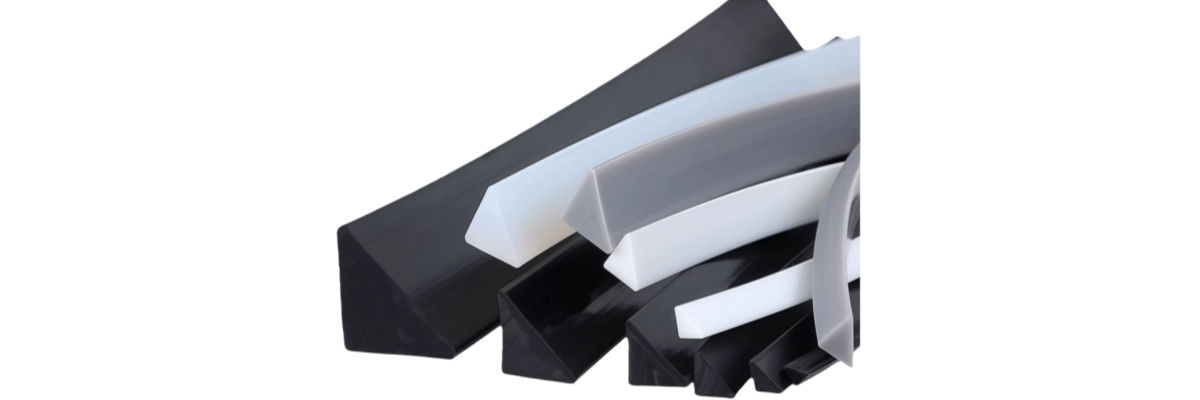
Triangular-Shaped Seal Strip
A Triangular Seal (commonly called a Wedge Seal or V-Seal) is an elastomeric gasket with a triangular cross-section, typically shaped like a right triangle or an isosceles triangle. It is designed for sealing in corner junctions and angled gaps where two surfaces meet at an angle, most commonly 90 degrees.
How It Works & Key Advantages
The triangular geometry provides targeted sealing in angular interfaces:
Corner-Conforming Design: Naturally fits into 90-degree corners and angled joints, providing a space-filling seal that other profiles cannot match efficiently.
Dual-Surface Sealing: The two angled sides of the triangle compress simultaneously against two perpendicular surfaces, creating a reliable seal in the corner itself.
Gap Filling & Compensation: Effectively fills irregular or varying gaps in corner joints due to its solid or sponge construction, compensating for manufacturing tolerances.
Structural Support: Can act as a cushioning block or spacer to prevent over-compression of adjacent components in assembly corners.
Primary Applications
The triangular seal is specialized for corner sealing, cushioning, and gap filling in angular joints.
1. Windows, Doors & Curtain Walls:
Window/Door Frame Corners: Seals the internal 90-degree junctions where the vertical and horizontal frame members meet in aluminum, PVC, or wood windows/doors.
Glazing Corners: Used as a corner key or seal in the internal corners of insulated glass units (IGUs) or glazing systems.
Curtain Wall Joints: Seals corner intersections in structural glazing and unitized curtain wall panels.
2. Automotive & Transportation:
Door Frame Corners: Seals the junctions where the window channel meets the door frame or beltline.
Light Housing Seals: Used in the corners of headlight and taillight assemblies.
Interior Trim Corners: Seals and cushions joints where interior plastic trim panels meet at right angles.
3. Industrial & Electronics:
Enclosure & Cabinet Corners: Seals the internal corners of electrical enclosures, control cabinets, and junction boxes against dust and moisture ingress.
Machine Guard Corners: Provides sealing and cushioning at the corner joints of removable safety guards.
Battery Pack Sealing: Used in some electric vehicle battery trays to seal corner interfaces between modules and the tray.
4. Construction & General Manufacturing:
Prefabricated Panel Corners: Seals joints at the corners of insulated wall/roof panels in modular construction.
Ductwork & Ventilation: Seals corner joints in HVAC ducting systems.
Tank & Container Linings: Used as corner seals in liquid storage tanks or process vessels with liner systems.
Common Materials
EPDM Sponge/Rubber: Most common for weather-resistant applications (windows, automotive).
Silicone Rubber: For high-temperature or high-flexibility corner sealing.
PVC/Nitrile: For cost-effective general-purpose corner gaskets.
Neoprene: For applications requiring moderate oil/fuel resistance.
In summary, the Triangular Seal is a specialized corner sealing profile. Unlike strip seals designed for flat flanges, it is engineered specifically to solve sealing challenges in 90-degree and angled joints, providing reliable environmental protection and gap filling in window/door frames, enclosures, automotive components, and industrial assemblies.
0 Item(s)
Filter
All Items/In Stock
Category
Sort
Price Range
$
$